

Is AAF fit for today? What should Trustees be considering?
Is AAF fit for today? What should Trustees be considering? AAF 01/20 reports began appearing
We hear a lot about succession planning for trustees, with the General Code referencing the need for structured succession planning, phased handovers, shadowing arrangements, and ongoing training to ensure continuity as a key part of a Risk Management framework. We see less attention given to succession planning for in-house pension managers and how this impacts Risk Management from the loss of knowledge and potential disruption to the existing team.
The Pension Manager plays a vital role in overseeing scheme administration, governance, regulatory compliance, and member communications. Without proper succession planning, companies risk operational inefficiencies, compliance issues, and a loss of strategic oversight. Based on our experience of supporting organisations with their succession planning, we have identified the following key elements:

Many in-house pension functions depend heavily on the historical knowledge of a single individual. To maintain continuity and strong governance, we have helped in-house teams to document policies, procedures, and key decision-making processes. Using a centralised knowledge hub can also help track compliance deadlines, scheme governance structures, and key contacts to help understand the succession planning requirements.
Existing processes can be evaluated in-house to identify gaps in documented knowledge, with practical solutions developed to integrate, where possible, with the team’s existing resources. It can often be useful to add an objective perspective, to help build a foundation for the pension manager succession including looking at alternative options available within the wider team alongside the potential for outsourcing as part of the Company’s overall resource management.
Ideally, a successor is identified well before a pension manager’s departure, allowing for a structured handover period of six to twelve months. This ensures a smooth transfer of knowledge, introduces key stakeholders, and safeguards business continuity.
Finding the right candidate for this niche pension role can take time. Designing an effective interview process and structured onboarding is crucial, particularly as these roles often fall outside the expertise of internal recruitment teams. Where internal succession is the preferred route, a clear assessment of team structures, skill gaps, and backfill requirements is needed to help shape a sustainable long-term plan.
We have found that an objective perspective, along with tools and templates, enables in-house teams to navigate the process more efficiently. By alleviating the burden of this time-consuming task, the in-house team can stay focused on the day-to-day, while still allowing management to retain control over key decisions in selecting the right candidate.
The role of the traditional in-house pension manager is increasingly being outsourced. Third-party consultants, governance specialists, or fiduciary managers can oversee key responsibilities, such as scheme governance, regulatory compliance, and employer/trustee liaison, removing some of the traditional pension manager duties.
There is also the potential to fully outsource the role, where the service, for example, acts as a bridge between the Trustee Board and the Company, including managing budgets effectively and supporting HR teams in enhancing member engagement. There are a number of different outsourced models and understanding where the role fits within the wider risk management and governance framework is key to ensuring companies navigate any move to outsourcing as smoothly as possible.
Finally, where it isn’t possible to enable a structured handover period, bringing in an interim professional can provide immediate expertise and adaptability, ensuring smooth scheme operation without the pressure to rush a long-term hiring decision. Whether covering a vacancy, managing a project, or supporting a team through a transition, an interim professional can offer a flexible solution that maintains momentum and governance integrity during periods of change.
At Pi Partnership we believe that in-house pension management succession planning should be as robust as that of trustee roles. Whether through structured handovers, internal development, outsourcing, or interim solutions, businesses must proactively prepare for pension manager transitions. By addressing this often-overlooked area, businesses can ensure continuity, compliance, and the long-term health of their pension schemes.
Is AAF fit for today? What should Trustees be considering? AAF 01/20 reports began appearing

Pension scheme data cleansing goes beyond correcting member records. It involves reviewing scheme documents, understanding past decisions and addressing issues that can affect members’ benefits. From a professional trustee’s perspective, this article explores why projects become complex and how expertise, constructive challenge and timely decisions help trustees navigate them.
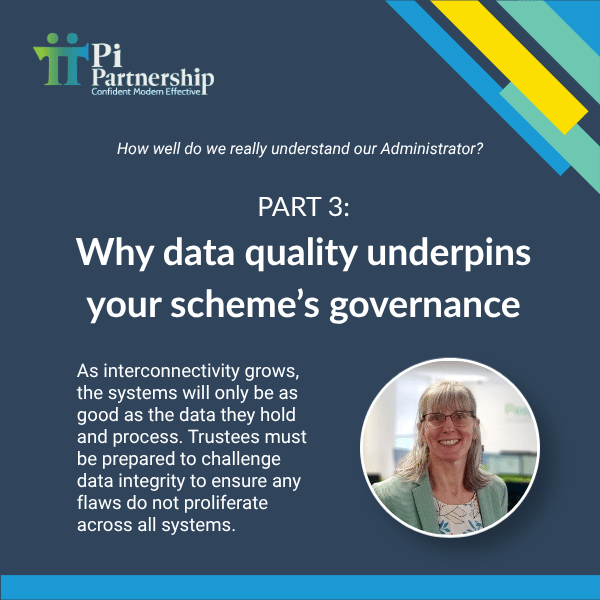
Good-quality pension scheme data is fundamental to effective governance, compliance and risk management. As systems become increasingly interconnected and AI adoption grows, trustees must understand how data is managed, shared and scrutinised to support better decisions and member outcomes.

Everyone has different needs, and we support this balance offering true flexibility in how our people manage their time and fully support part time working and a family friendly approach.

We believe in clear and transparent communication and create regular opportunities for internal communication. Our regular business updates and opportunities to input into the business ensures everyone feels part of the team and on the same page at Pi, ensuring our hybrid working model is effective regardless of where you are based.

Nurturing every Pi Person is important to us and we want to ensure everyone has the opportunity for continued professional development by providing the space to do this alongside client commitments. Everyone has an individual Personal Development Plan catered to them, whether they are on the start of their journey with Pi or those looking at ways to transition into the next stage of their careers.
Everyone has the opportunity for a regular development and progression review and everyone has ownership over their own development with input and guidance of senior member of the team where required.
We provide regular opportunities to share knowledge amongst our teams through Lunch Time Learn in sessions and actively encourage involvement and participation into this.

We are an open, friendly and supportive team who thrive in a flexible and autonomous environment. Our people are trusted to get on with things, adding value and individual contribution, whilst maintaining a good work life balance and ideally having fun along the way.
We want to ensure we cultivate our special culture and our focus is to maintain our exceptional engagement levels. We are proud to have been awarded the Sunday Times Best Place to Work for small businesses in 2023 and 2024, and also in 2025 after moving to the medium-sized business category.

Our employee ownership structure is central to our philosophy of making sure every Pi Person is part of our success story, contributing to how we run the business, and sharing in the profits. We know that being successful is not just down to numbers, it’s about our people who all contribute in their unique way to our success and creating a working environment where everyone has a voice.


Amanda is a Board Director of Pi Partnership Group and leads the development of Pi’s services. She works closely with clients, the Pi team and professional advisers to ensure all of Pi’s services meet the changing needs of the pension market and deliver clear value to Pi’s clients.
Amanda has over twenty-five years’ experience in the pensions industry and, as well as ensuring Pi’s services continue to meet the needs of our clients in a rapidly changing pension landscape, is also a member of Pi’s Executive Management Team. She provides specialist project management for clients on a range of services, including adviser selection and review, trustee board assessment and governance design.
As well as being a Fellow of the Pensions Management Institute (PMI) and Chair of the PMI London Group, Amanda holds PMI certificates in Pensions Automatic Enrolment and DC Governance, was a past Prince2 practitioner and is a Certified Risk Management Practitioner.
What do you most enjoy about your role: Successfully delivering complex projects and creating a happy team environment.
Interests outside work: Travel, theatre and as part of Abundance London helping create beautiful spaces in urban settings.
Top achievement to date: Competing in the 2005/06 Round the World Clipper race.